Growth Doesn’t Make A Global CEO, Institution-Building Does — Access Holdings GMD, Innocent Ike

Growth alone does not make a global Chief Executive. What does, is the rare ability to build enduring institutions that convert scale into lasting value.
This was the powerful submission of the Group Managing Director/Chief Executive Officer of Access Holdings Plc, Mr. Innocent C. Ike, at the Stanford Seed G3 (Growth, Grit and Global) 2026 Conference.
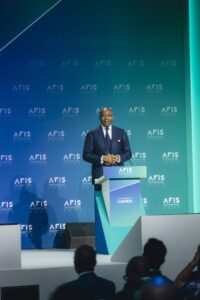
Delivering the keynote address titled “The Mindset of a Global CEO” at the Landmark Event Centre, Lagos, on October 14 and 15, Ike said a global CEO is not judged by the number of countries his organisation flies its flag in, but by the quality of decisions he takes amid complexity.
The two-day conference, convened by the Seed Transformation Network, Nigeria, brought together a constellation of entrepreneurs, investors, corporate titans, policymakers and changemakers to celebrate the economic and creative power of African entrepreneurs who are scaling businesses, creating jobs and transforming communities.
Beyond the plenary, the venue was a hive of enterprise. A Deal Room strategically connected high-growth businesses with prospective financiers, while exhibition booths showcased cutting-edge products and solutions. Access, a proud partner of the conference, used its booth to unveil its bouquet of offerings and engaged budding entrepreneurs in the Deal Room on financing opportunities.
The conference paraded an impressive roll call of dignitaries, including Dr. Bosun Tijani, Minister of Communications, Innovation and Digital Economy; Mrs. Aisha Rimi, CEO, Nigerian Investment Promotion Commission; Mrs. Ayodele Olojede, COO, Development Bank of Nigeria; Mr. Iyin Aboyeji, Founding Partner, Future Africa; Mrs. Omolola Ajani, President, Stanford Seed Transformation Network; Mrs. Feyisola Abiru, Member, Board of Trustees, Seed Network Nigeria; Mr. Julius Agenmonmen, GMD/CEO, Brandlife Limited; and Mr. Lanre Adesuyi, CEO, Havilah Group.
Seed Transformation Network, Nigeria, is an arm of the Stanford Seed Transformation Program, established by Stanford University’s Graduate School of Business to equip leaders of established Small and Medium-sized Enterprises in emerging markets with the leadership, strategy and operational muscle to scale sustainably. The programme boasts a network of over 1,500 business leaders across Africa and South-East Asia.
“Many executives can grow a business. Far fewer can build an organisation that can operate across multiple jurisdictions, attract capital at scale, develop leaders across generations, and earn the trust of customers, regulators, and investors,” Ike declared.
“Scale is the outcome. Institution building is the capability,” he stressed.
According to him, while scale brings mouth-watering benefits – access to new markets, operating leverage, a wider pool of capital and greater influence – it does not automatically translate to better economics. Expansion, he warned, must be a deliberate, disciplined choice.
“Every growth plan should show what the institution will do better for its customers, investors, talent, markets and stakeholders. Scale is a platform for value creation. It is not the value itself,” he said.
Ike described the transition from founder-led growth to institution-led value as the defining moment for any enterprise: “The enterprise becomes globally scalable when success no longer depends on the continuous presence of one individual.”
He then unveiled six disciplines that define a global CEO: thinking beyond geography; allocating capital objectively; building institutions rather than empires; competing against global standards; balancing opportunity with risk; and optimising for sustainable value.
Every growth ambition, he noted, ultimately becomes a decision on how to allocate financial capital, regulatory capital, people, technology, reputation and management attention. Leaders must therefore test strategic conviction against risk-adjusted returns, resilience and regulatory approval.
On the role of technology, he was succinct: “Technology accelerates scale. Artificial intelligence amplifies judgement. Brand converts performance into trust.” He called for responsible deployment of AI and strong cyber resilience across all markets.
For African businesses with global ambition, he listed nine leadership priorities, including putting governance in place before complexity sets in, building credibility with regulators, developing leadership depth, and standardising what must travel across markets while adapting what must stay local.
He closed with five acid tests for every growth plan: What becomes measurably better for the customer? What becomes stronger and more resilient in the institution? What value becomes more durable for society? What becomes more credible and responsible? And how does scale create sustainable returns for shareholders?
“African businesses do not need smaller ambitions. They need stronger institutions around those ambitions,” he charged.
“Scale creates opportunity. Institutional discipline makes value endure.”
About The Author